April 2026 · Peer Review Event · This Gallery
The Collective Eye:
A Study in Perception
By Daniel Ali Velázquez de Pool
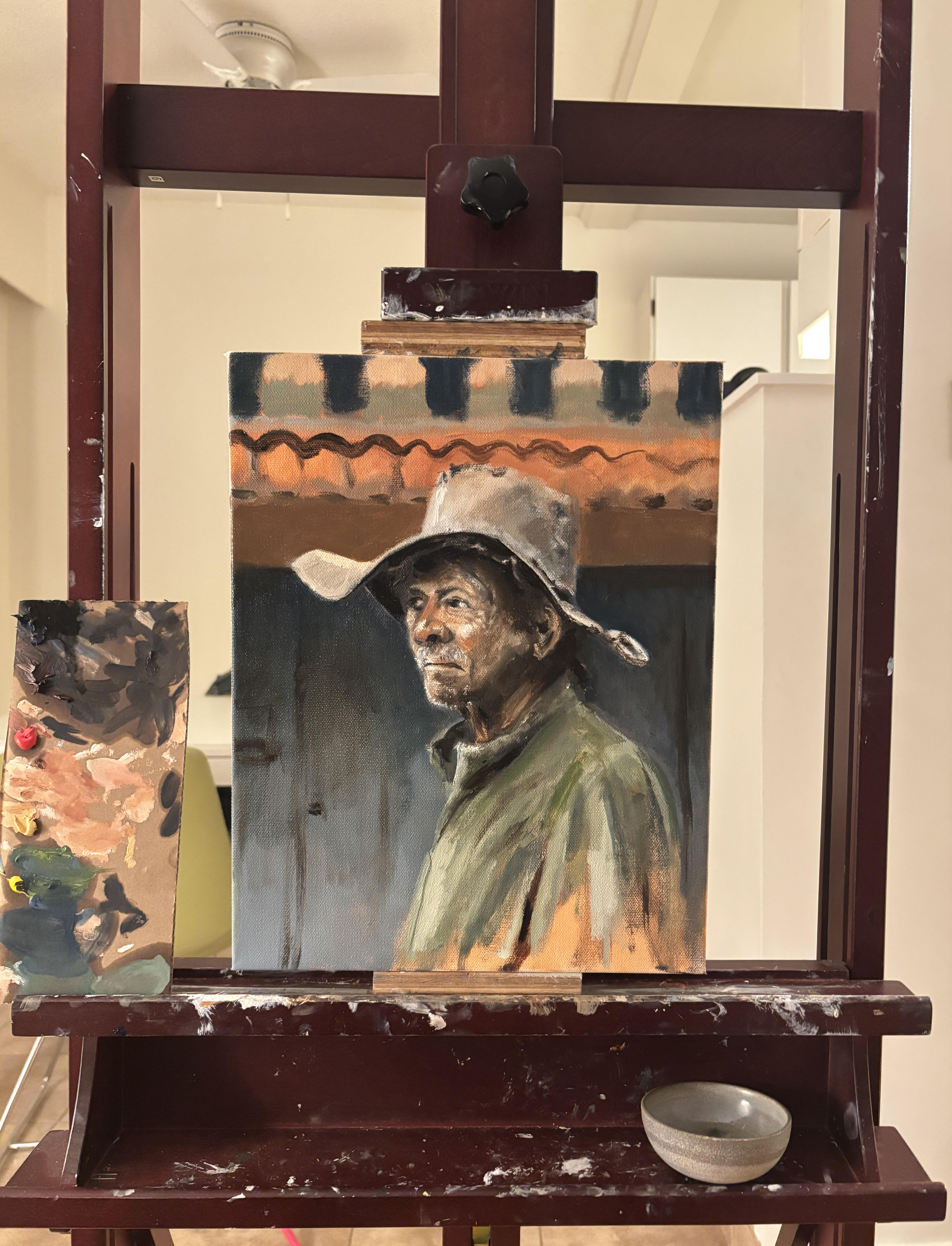
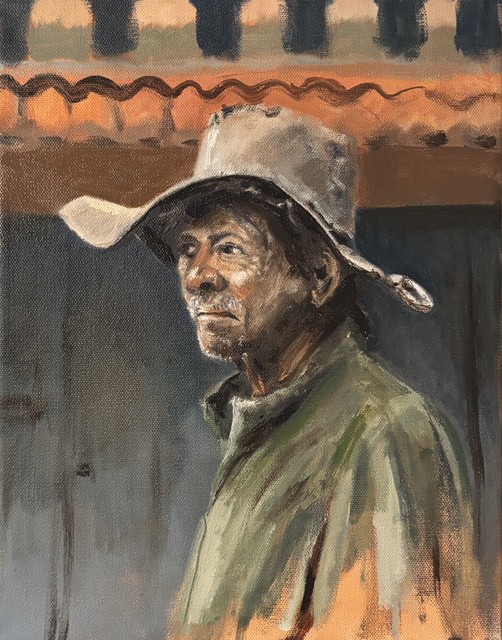
In the practice of Structural Impressionism, a painting is never a solitary statement; it is a construction completed by the viewer's eye. Recently, at This Gallery, I participated in a peer-review exercise curated by the Gallery Director. This was not a traditional exhibition, but a dynamic interrogation of my work, The Man of Maracaibo, using a live-data interface to map the visual priorities of a professional audience.
The goal was to deconstruct the act of looking: Does the artist's technical intention align with the atmospheric reality experienced by a curated group of critics and peers?
The Perception Map
Quantitative Hierarchy
Using a custom-built application, a cohort of artists and critics recorded their primary points of engagement. The resulting data revealed a decisive visual hierarchy, suggesting that even among professionals, we find common ground in the space a subject occupies before we move into their individual identity.
| Point of Interest | Engagement Level | Artistic Significance |
|---|---|---|
| The Background | Dominant | The atmospheric gateway to the narrative. |
| Eyes / Gaze | High Tension | The psychological anchor of the study. |
| General Attention | Unified | Proof of a well-resolved, holistic composition. |
| The Hat & Chin | Targeted | Strategic catalysts for anatomical resolution. |
Artistic Insight · Atmospheric
Synchronizing the Atmospheric Insight
The most compelling result was how the quantitative data synchronized with the qualitative feedback. The audience was highly sensitive to the "unspoken" parts of the canvas — the blurry environment and the terracotta shadows — identifying them not as a lack of detail, but as a vital provider of contextual heat.
"The background seems blurry, but it adds context… the terracotta tiles at the back give a nice touch of depth."
This validates a core tenet of Impressionism: the "unfinished" space allows for the "Beholder's Share." As art historian E.H. Gombrich noted in Art and Illusion, the viewer's imagination completes the gaps left by the artist's brush. By focusing on the background, the audience felt the sun of Maracaibo before they met the man himself.
Artistic Insight · Detail
The Catalyst of Detail
A fascinating tension emerged regarding the lower face. While the Mouth and Chin received lower quantitative engagement, they received the highest level of technical praise:
"Impressive use of white. You thrived in the good use of it at the hat and chin highlights."
This proves that in a balanced work, certain elements exist as visual catalysts. The white highlights served their purpose instantly; they "resolved" the anatomy for the professional eye, allowing the gaze to move quickly back to the psychological intensity of the eyes.
Artistic Insight · Narrative
Temporal Displacement and Narrative Projection
The exercise moved from the technical to the narrative as the participants projected a history onto the subject, searching for his "era" and "status":
"Is he from another era?"
"He seems to be a leader or a manager somehow."
"I can clearly see the narrative of this person and it makes me feel foreign to it."
The limited palette on plywood successfully created Temporal Displacement. By stripping away the modern, the work presented a subject that felt archival and authoritative. As noted in John Berger's Ways of Seeing, "The way we see things is affected by what we know or what we believe." The focus in his eyes demanded a belief in the subject's authority.
The impression is not made by the artist alone — it is completed by every eye that enters the frame.
Next Evolution · Perspective & Contrast
The Street Speaks for Itself
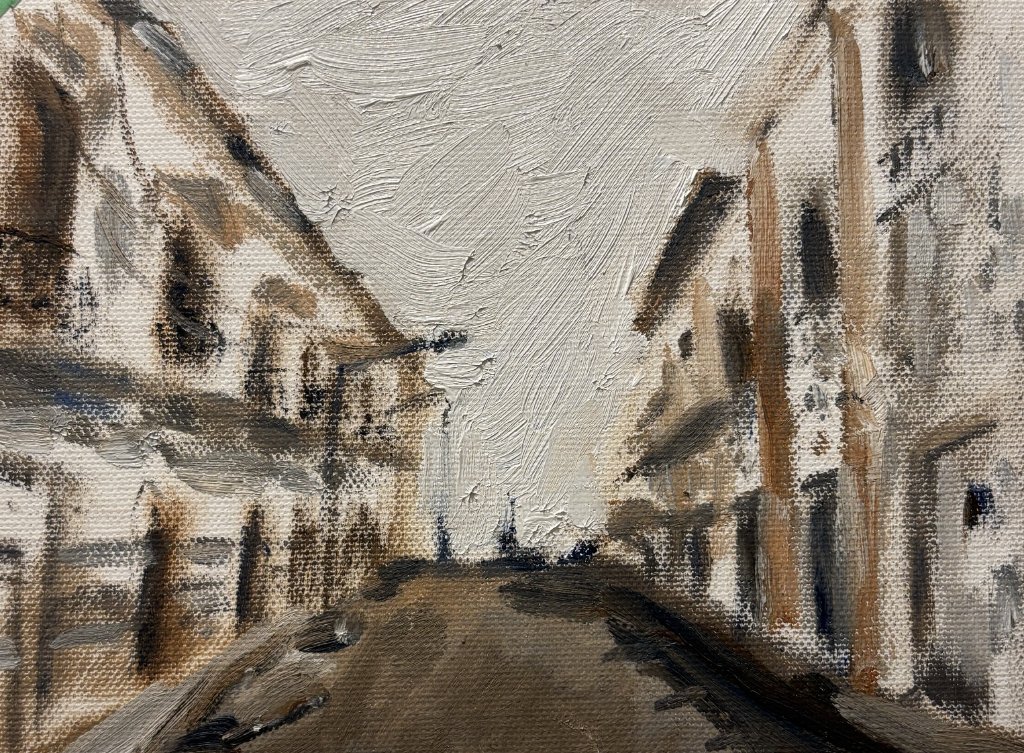
The collective study has pushed me toward a new formal question: what happens when the portrait disappears entirely — when there is no singular face to anchor the eye?
In Maracaibo Point of View, the street itself becomes the subject. A central vanishing point pulls the gaze deep into the canvas, flanked by facades dissolving into shadow. Buildings are suggested, not described. Figures are absent, yet their presence is implied by the worn road, the architecture of daily life framing the void. The viewer is placed inside the scene — not observing it, but walking it.
When you remove the face, you return the gaze to the space between things — and that is where the real narrative lives.
Shadow here is not decorative. It is structural. The deep darks on either side compress the composition, forcing attention toward the pale, luminous sky at the centre. Contrast becomes direction. The eye has no choice but to move forward, drawn by light the way a person is drawn down an unfamiliar street — not by what they see at the end, but by the curiosity the space itself generates.
This is the next chapter in Structural Impressionism: letting perspective and tonal contrast do the work that expression once did. The street holds the narrative. The viewer completes the journey.
Conclusion
Art as a Shared Structure
This exercise at This Gallery proved that the "impression" is a collaborative act. While the background draws the viewer in, it is the gaze that holds them accountable.
To the artists and critics curated for this session: thank you for helping me map the structure of this impression. Your reflections are now a permanent layer of the work.
Daniel Velazquez
Painter · Vancouver, BC · April 2026